True cost of Cross Board Payments
Transparency & Trust
When a business or individual sends money internationally, the fee shown at checkout is rarely the whole story. Understanding how cross-border payment costs are actually structured — and where value quietly disappears along the way — is the first step toward making better financial decisions.
The Visible Fee Is Only Part of the Picture
Most cross-border payment providers display a single transfer fee. It looks clear. It looks fixed. And for many customers, it is the only number they examine before confirming a transaction.
But the economics of a cross-border payment are more layered than a single line item. The fee you see covers the provider's visible charge. What it does not always show is where the exchange rate was set, how far that rate sits from the real mid-market rate, whether intermediary banks take a cut along the routing chain, or what the recipient actually receives at the other end.
The most meaningful question is not "what is the transfer fee?" It is: how much does the recipient actually receive, and what was the true all-in cost of moving that money?
Where Cost Hides in a Cross-Border Payment
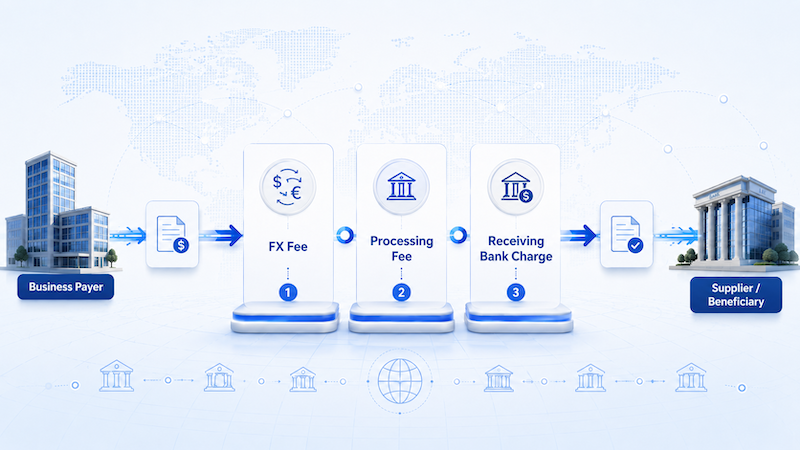
There are typically three places where value erodes in a cross-border transfer:
|
Layer 1 The FX Margin The gap between the rate offered to the customer and the real interbank rate. Often the largest hidden cost — and the least visible. |
Layer 2 The Transfer Fee The visible upfront charge. Usually the number most prominently displayed — and often not the biggest cost in the transaction. |
Layer 3 Correspondent & Receiving Fees Charges applied by intermediary or receiving banks along the payment route. Often unknown to the sender at the point of transfer. |
For small personal transfers, the FX margin might cost more than the declared fee. For larger business payments, even a modest spread compounds into a meaningful number. For high-volume or recurring payments — supplier settlements, operational payrolls, recurring collections — the cumulative effect is significant.
Why This Problem Persists
The opacity in cross-border payment pricing is not accidental. It is structural. Pricing complexity makes direct comparison difficult. FX margins are not regulated the way explicit fees are. Correspondent banking networks involve multiple parties, each with their own cost structure. And many customers — understandably — focus on the declared fee and assume it represents the full cost.
Traditional providers have had little competitive pressure to simplify this. If comparison is difficult, pricing discipline is also difficult to enforce from the customer's side.
An honest pricing model does not require customers to do the arithmetic themselves. It shows total cost clearly, converts at a rate that can be verified, and does not recover margin in ways that are invisible at the point of decision.
What Transparent Pricing Actually Looks Like
Pricing transparency is not just a marketing claim. It is a design decision. A provider serious about transparency will typically:
- Show the exchange rate used — and make it easy to verify against a real-time reference rate
- Separate the FX component from the transfer fee so customers can see both clearly
- State the expected recipient amount before the transaction is confirmed, not after
- Be upfront about any fees that may be applied by receiving institutions — even when outside the provider's direct control
- Price consistently, without promotional rates that obscure the real ongoing cost
None of this requires subsidising transfers or offering loss-leader pricing. It requires a commitment to legibility — that customers understand what they are paying and why, before they confirm.
For Businesses, the Stakes Are Higher

Individual senders lose value to hidden margins on each transfer. For businesses — particularly those making regular international payments, settling with overseas suppliers, or managing multi-currency cash flows — the aggregate effect is larger, and the operational problem is compounded.
A business paying multiple suppliers in different currencies, each through a different bank or provider, faces fragmented pricing, inconsistent FX treatment, variable settlement times, and no clean picture of its true payment costs. Reconciliation becomes manual. Budgeting becomes imprecise. Treasury decisions are made on incomplete information.
Better pricing transparency is not just a fairness issue for businesses — it is an operational one. When costs are clear and predictable, financial planning becomes more reliable.
Questions Worth Asking Any Cross-Border Payment Provider
Before committing to a provider or corridor, these are the questions that matter most:
- What exchange rate will be applied to my transfer, and how does it compare to the current mid-market rate?
- Is there a separate FX margin, or is it built into the transfer fee?
- What will the recipient actually receive, stated in the destination currency, before I confirm the transaction?
- Are there any fees applied by intermediary or receiving banks that may reduce the amount delivered?
- How does your pricing change for higher-value or higher-volume transfers?
- Is the rate I see today the rate I will receive consistently, or does it vary based on conditions I cannot predict?
How We Think About This at WealthGate International Trading
We are a licensed payment service provider in Singapore, regulated by the Monetary Authority of Singapore, focused on cross-border money movement for individuals and businesses. Our goal is to operate in a way that is commercially straightforward — where the cost of a transfer is stated clearly, the rate used is verifiable, and customers are not left calculating what they actually paid after the fact.
We do not claim to be the cheapest option in every corridor or for every customer. We do aim to be the option where the cost is clear enough that customers can make that judgement for themselves.