Pay Overseas Staff and Contractors from Singapore
More Singapore businesses are choosing to pay overseas staff and contractors directly in local currency — and the reasons go well beyond convenience. Singapore is one of Asia’s most globally connected business hubs, and most companies here reach far beyond the island’s borders when it comes to talent. Developers in Vietnam, account managers in Malaysia, factory supervisors in China, freelance designers in the Philippines: the regional workforce that supports Singapore businesses is enormous. But paying them in their own currency, reliably and cost-effectively, remains harder than it should be.
This guide covers everything Singapore companies need to pay overseas staff and contractors from Singapore — the mechanics, the true costs, the compliance context, and which payment method makes sense for your situation.

Why Paying in the Recipient’s Local Currency Matters
Many Singapore companies default to paying overseas staff in SGD and leaving the currency conversion to the recipient. On the surface this looks simpler — you know exactly what you’re spending, and your accounting is clean. In practice, it places the FX risk and conversion cost on the employee or contractor, which creates several problems.
A freelance developer in Vietnam who invoices SGD 2,000 every month has no way of knowing whether they’ll receive VND 34 million or VND 36 million when the funds clear. That 5–6% swing is the difference between a profitable month and a tight one. Over a year, the cumulative FX drag can amount to more than a week’s pay — an invisible cost your contractor carries but your competitors may absorb for them.
Paying in local currency signals that you understand your staff’s reality. It also makes your fee structure more competitive when hiring across borders, where candidates increasingly expect transparent, local-currency compensation.
Key principle: When you pay in your recipient’s local currency through a licenced payment institution, the exchange rate and any fees are locked and confirmed before the transfer is sent. The recipient knows exactly what arrives. There are no surprises on either side.
Compliance Context for Singapore Businesses
Before covering the mechanics, it is worth understanding the regulatory and contractual context in which these payments sit. You can verify any MAS-licensed payment institution at the MAS Financial Institution Directory.
Employment Act applicability
Singapore’s Employment Act covers employees who perform work in Singapore. Overseas-based staff — including those employed directly by a Singapore entity but physically working abroad — are governed primarily by the employment laws of their home country, not Singapore’s. Your contracts with overseas employees should reflect this, and you should take local legal advice in each country where you have people on payroll.
Independent contractors vs. employees
Many Singapore companies engage overseas talent as independent contractors rather than employees. This simplifies compliance considerably: the contractor is responsible for their own tax obligations in their home country, and there is no employment relationship that triggers local labour law. However, misclassification risk is real — if someone works exclusively for you, is supervised by you, and uses your tools, some jurisdictions will treat that as employment regardless of how the contract is labelled.
Transfer regulations in destination countries
Most ASEAN and Northeast Asian countries permit inbound transfers from overseas employers without restriction for employment or contractor payments. China is a notable exception: inbound transfers for service fees and salaries must flow through compliant channels, and the transfer purpose code must correctly describe the payment. A licenced payment institution with China expertise — specifically one operating under the People’s Bank of China PSN11 framework — handles this correctly by default.
Note on China payroll: Paying a China-based employee directly to a personal CNY bank account via standard SWIFT can trigger compliance issues at the receiving bank. Transfers labelled as “salary” or “service fee” to Chinese accounts require proper documentation and purpose codes. Use a payment provider that has established PSN11-compliant channels for China.
Which Currencies Are Most Commonly Needed
Singapore companies most frequently need to pay overseas staff and contractors in the following currencies:
The right payment method varies somewhat by corridor. CNY payments require the most care due to China’s capital controls. MYR, IDR, VND, PHP, and THB are all accessible through licenced non-bank providers and typically settle faster than bank TT. USD payments — common when a contractor invoices in dollars regardless of their home country — are the most straightforward.
Your Options: A Practical Comparison
Singapore businesses generally have four routes for paying overseas staff and contractors in local currency. Here is how they compare on the factors that matter most.
| Method | FX transparency | Total cost | Speed | Best for |
|---|---|---|---|---|
| Bank TT | Rate disclosed at time of booking only; margin not shown | S$15–35 outgoing fee + correspondent charges + 1.5–2.5% FX spread | 2–4 business days | Occasional, large one-off payments where speed is not critical |
| Global payroll platform | Rates embedded in monthly subscription; visible at checkout | US$49–599/month per contractor depending on plan; FX margin varies | 1–2 business days | Teams of 5+ contractors needing full HR and compliance management |
| Consumer remittance app | Rate and fee shown upfront | Low per-transfer fee; volume discounts limited; not designed for B2B | Minutes to 1 business day | Very small businesses with 1–2 individual payments per month |
| MAS-licensed payment institution (e.g. Wealthgate) | Rate, fee and exact recipient amount confirmed before every transfer | Competitive FX rates; all fees disclosed; no hidden correspondent deductions | Within 24 hours for most ASEAN corridors | Singapore businesses making regular multi-currency staff or contractor payments at volume |
The Hidden Cost Problem With Bank Telegraphic Transfers
Most Singapore businesses default to bank TT because it is familiar and sits within the same banking relationship they use for everything else. But the true cost of a bank TT for overseas staff payments is typically higher than it appears at the time of booking.
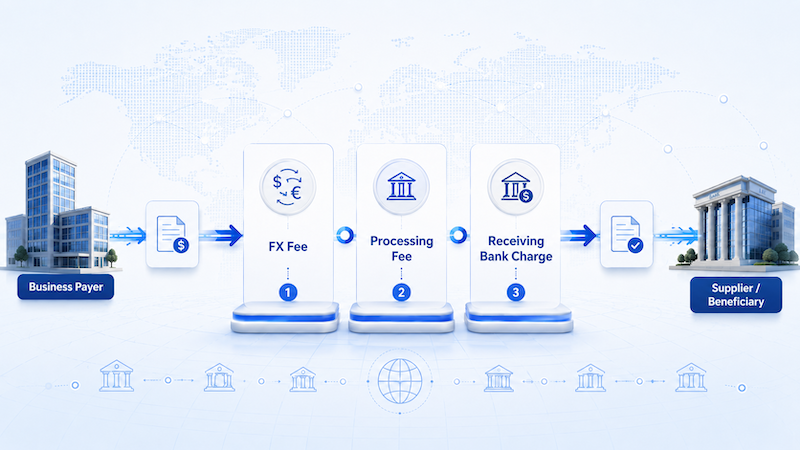
Three layers of cost compound in a standard SWIFT transfer:
1. The outgoing TT fee. traditional banks each charge a flat outgoing TT fee, typically SGD 15–35 per transaction. For small monthly contractor payments of SGD 500–2,000, this fee alone represents 1–7% of the transfer value.
2. The FX spread. The exchange rate your bank applies is not the interbank rate. Banks typically build in a margin of 1.5–2.5 percentage points above the mid-market rate. On a SGD 5,000 payment, that is SGD 75–125 in FX cost that never appears as a line item on your statement.
3. Correspondent bank charges. SWIFT transfers often pass through one or two intermediary banks before reaching the recipient. Each may deduct a service fee — typically USD 10–25 — from the transfer amount. Your contractor receives less than you sent, and neither of you knew in advance exactly how much less.
Example: You send SGD 3,000 to a Vietnam-based developer. After the TT fee (SGD 20), FX spread (approximately SGD 60), and one correspondent bank deduction (USD 15, equivalent to approximately SGD 20), your developer receives the equivalent of roughly SGD 2,900 — not SGD 3,000. That shortfall comes as a surprise to both parties.
How a MAS-Licensed Payment Institution Handles It Differently
A MAS Major Payment Institution operating cross-border money transfer services under the Payment Services Act is regulated to handle exactly this use case. Wealthgate holds MPI licence PS20200436, which covers outbound transfers to 30+ currencies from Singapore.
The key differences from bank TT are:
Rate and cost locked before you confirm
Before any money moves, you see the exchange rate, the transfer fee, and the exact amount your staff member or contractor will receive in their local currency. You confirm only when you are satisfied with all three numbers.
No correspondent bank deductions
Unlike SWIFT transfers that route through intermediary banks, transfers made via a licensed payment institution typically settle directly to the recipient’s account in the destination country via local payment rails. The amount quoted is the amount received.
Faster settlement
Most ASEAN corridors — Malaysia, Indonesia, Vietnam, Thailand, Philippines — settle within one business day, often same-day. China typically settles within 24 hours on PSN11-compliant channels.
Dedicated support, not a call centre
Wealthgate provides account-level support. When you have a payment that needs to be tracked, amended, or escalated, you speak to the same team that processed it — not a rotating queue.
Audit-ready records for every transfer
Each transfer generates a full record showing the sending amount, exchange rate, fees, recipient amount, and settlement confirmation. This is the documentation your finance team needs for expense reconciliation and, where applicable, IRAS reporting.
How to Pay Overseas Staff and Contractors from Singapore: A Practical Setup
If your business is ready to move away from bank TT and establish a proper process, here is a straightforward path to follow. Most Singapore companies that pay overseas staff and contractors from Singapore find that getting the first transfer right is the hardest part — after that, it becomes routine.
Step 1: Collect the right recipient details
For most ASEAN corridors you need the recipient’s full legal name, bank name, account number, and branch code (or equivalent routing identifier). For China, you additionally need the recipient’s national ID number and the bank’s CNAPS code. Collecting this during onboarding — not at payment time — removes delays later.
Step 2: Define your payment currency upfront in the contract
Specify in the service agreement or employment contract whether payment will be made in SGD or local currency, and which party bears any FX fluctuation. Paying in local currency through a transparent provider means you control the rate at the time of each transfer — this should be documented.
Step 3: Establish a regular payment cadence
Batch payments made on a regular schedule (e.g. the last business day of each month) are more cost-efficient and predictable than ad-hoc transfers. Your payment provider can help you set up a process that handles multiple recipients in different currencies in a single workflow.
Step 4: Keep your supporting documentation
For each transfer, retain the invoice from the contractor, the transfer confirmation showing exchange rate and recipient amount, and your payment instructions. This satisfies both your own accounts and any future IRAS queries about business expenses paid overseas.
Frequently Asked Questions
Can a Singapore company pay overseas contractors without a local entity in the destination country?
Yes. Paying an overseas contractor as a service provider does not in itself require you to establish a legal entity in their country. You are paying for services rendered, which is a cross-border commercial transaction. The contractor handles their own tax obligations locally. However, if the contractor is structured and supervised as an employee, some countries may treat the relationship as creating a taxable permanent establishment — seek local legal advice if you have any doubt.
Is there a minimum transfer amount for cross-border staff payments?
This depends on your payment provider. Bank TT minimums are typically SGD 500–1,000 before the fixed fee becomes cost-prohibitive as a percentage. Licensed payment institutions like Wealthgate do not impose minimums that make small contractor payments uneconomical — the fee structure is designed to be proportionate at various payment sizes.
What exchange rate should I use for accounting purposes when paying in foreign currency?
IRAS accepts the exchange rate at the date of payment as the basis for converting foreign-currency expenses to SGD for tax purposes. Your payment provider should issue a transfer confirmation showing the exact rate applied, which you can use directly in your accounts. Keep these confirmations alongside your contractor invoices.
How do I handle withholding tax for overseas contractors?
Singapore imposes withholding tax on certain payments to non-resident individuals for services rendered in Singapore. If your overseas contractor is working entirely from their home country — never physically present in Singapore — withholding tax generally does not apply to those payments. If they visit Singapore to perform services, different rules apply. Consult your tax adviser for the specifics, or refer to the IRAS withholding tax guidance for an overview of Singapore’s rules.
Can I pay multiple overseas staff in different currencies in a single batch?
Yes. A licensed payment institution designed for business use handles multi-currency batch payments as a standard feature. You submit your payment list — each recipient with their currency and amount — confirm the rates and fees for the full batch, and settle in one step. This is considerably more efficient than initiating individual bank TTs for each recipient.
Ready to pay your overseas staff and contractors more efficiently?
Wealthgate is a MAS-licensed Major Payment Institution. We handle cross-border staff and contractor payments to 30+ currencies from Singapore — with the rate, all fees, and the exact amount your recipient receives confirmed before every transfer.