
Can you fund a Singapore bank account through a remittance company
November 23, 2026
Before you fund a Singapore bank account from overseas through a remittance company, check whether your bank requires a same-name transfer for the first deposit. For eligible transfers, SGD can be sent on your behalf and the payment instruction can identify you as the payer. Ask whether the bank accepts that arrangement or requires the SGD to come directly from a bank account you own.
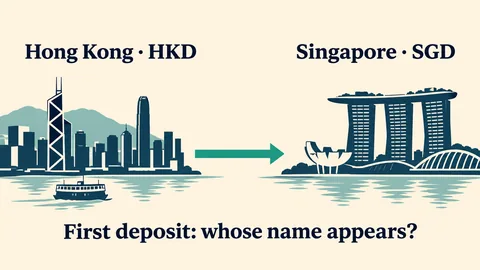
Suppose you’ve sold a property in Hong Kong and want to transfer HK$500,000 from your personal HKD account to your new Singapore account. Both accounts are in your name. If you use a remittance company to convert the HKD, one question remains. Whose account will actually send the SGD to Singapore?
Using a remittance company to fund a Singapore bank account from overseas? Wealthgate can confirm whose account will send the SGD, where your name will appear in the payment instruction and what proof of payment you can obtain after the transfer. If your bank requires a same-name transfer for the first deposit, use those details to check whether it accepts the arrangement before you book an exchange rate.
Read the exact wording your bank gave you. If it says “you must be identified as the payer”, ask where your name needs to appear on the payment. If it says “the deposit must come from a bank account held in your name”, check who owns the account sending the SGD. In the Hong Kong example, your bank statement shows who paid the HKD. The receiving bank may also need to establish who sent the SGD.
| If the funding instructions say… | What to establish before booking |
|---|---|
| “The account holder must be identified as the payer.” | Ask which payer details the bank needs. On an eligible route, the payment instruction can identify the customer on whose behalf the funds are sent. Wealthgate can confirm where that information will appear. |
| “The first deposit must come from a bank account in your own name.” | Confirm who holds the account that will send the SGD. If another party holds it, the receiving bank would need to agree to that arrangement before you proceed. Your name in the payment details alone does not satisfy an express own-account requirement. |
| “Include the customer name or reference.” | Use the reference the receiving bank specifies so it can match the incoming credit to your account. If the bank also needs evidence of who sent the money, ask which payment record it accepts. |
If the instruction simply says “same-name transfer”, you can ask the bank directly.
“For this first deposit, can you accept SGD sent on my behalf if the payment instruction identifies me as the payer, or must the SGD come directly from a bank account I hold in my own name?”
Once that is clear, check the minimum deposit, currency, deadline and whether the amount must arrive in a single transaction. If the bank requires one credit, confirm that the proposed payment will arrive as one transfer before agreeing to the exchange.
The Hong Kong statement and the Singapore payment record answer different questions. The statement can show that the HKD came from your personal account. The onward payment instruction identifies who sent the SGD and, where the payment route supports it, the person on whose behalf the transfer was made.
For a proposed inward remittance to Singapore, ask for three details before booking.
A short entry on a bank statement may display fewer details than the payment instruction contains. If the receiving bank requires a particular field or document, share its wording with Wealthgate before sending. The bank can then assess how your specific transfer would arrive.
If you plan to fund a Singapore bank account with Hong Kong property sale proceeds, start with the amount that reached your Hong Kong account. The sale agreement shows the price. The completion statement explains any mortgage repayment and costs. Your bank statement shows the amount you actually received. The figures below illustrate how those documents fit together.
Here, the credit to look for on the Hong Kong bank statement is HK$1,880,000. Match that entry to the net proceeds on the completion statement. You can then explain in one sentence why the transfer is smaller: “I received HK$1,880,000 after the sale and would like to transfer HK$500,000 of that balance to Singapore.”
What if the proceeds are still with the solicitor? Say so at the start. Payment from a solicitor’s client account presents a different funding arrangement from payment out of the seller’s personal account. Before instructing the solicitor, clarify who will send the HKD, whether the arrangement is supported and which records connect the seller to the funds.
Keep the source of funds and the purpose of the transfer separate. “Proceeds from my Hong Kong property sale” explains how you obtained the money. The purpose explains what the payment is for, such as meeting relocation expenses in Singapore. Give the purpose that applies to your transfer. The receiving bank and remittance provider can each specify which documents they need.
If you hold Hong Kong dollars and want to fund a Singapore bank account, check which currencies the bank accepts for that deposit. If the account-opening instructions require SGD, compare quotes for SGD to be credited. If the account can receive and hold HKD, you can also compare the cost of sending HKD and converting it in Singapore.
To compare the HKD to SGD exchange rate fairly, start with the same total HKD budget. If you convert before sending, ask how much SGD is expected to reach the account after charges. If you send HKD first, ask which receiving instructions to use, whether any inward remittance fees apply and who sets the exchange rate when you convert.
Suppose you want to spend exactly HK$500,000. One illustrative quote confirms a net credit of S$82,100. Another indicates S$82,125 before receiving charges. If S$30 is deducted from the second payment, the account receives S$82,095. The apparently higher quote delivers S$5 less. These figures are an example, and the actual exchange rate and charges will depend on the quote.
What if the bank has given you a minimum first deposit in SGD? Suppose you need to fund a Singapore bank account with at least S$80,000. Ask the question the other way round: “How much HKD do I need to pay for S$80,000 to reach the account after charges?” Ask which fees the quote covers and whether the receiving bank could deduct anything further. If the final credit is an estimate, check how the bank treats a deposit that arrives just below the minimum.
There are also three dates worth distinguishing.
A quote valid until Friday afternoon tells you how long the price is available. If the deposit is also due on Friday, ask whether the money is expected to reach the account by the bank’s deadline before accepting the quote.
Start with the insurer’s payment instructions for the specific policy. For an overseas insurance premium payment, check which account to pay, the premium currency, the accepted payment method and the exact reference to use. An initial premium may use a proposal number, while a renewal may use the existing policy number. If the insurer accepts a telegraphic transfer, ask who bears the bank charges so the full premium reaches the insurer.
Who is funding the premium? If the policyholder uses their own money and the transfer is made on their behalf, ask whether the insurer accepts that arrangement and how the policyholder must be identified. Wealthgate can explain which payer details the available payment route transmits.
If the money comes from a spouse’s or company’s account, describe that separately. The insurer can confirm whether it accepts that payer and whether it needs a declaration or evidence of the relationship. The policy number helps the insurer allocate the payment. It may also need to establish who provided the funds.
What counts as paid by the deadline? If a renewal is due on Friday, ask what must happen by Friday and where to send proof if the policy record still shows an outstanding premium. Sending the transfer, the insurer receiving the funds and the premium appearing against the policy can occur at different times. Keep the payment confirmation until the insurer confirms the full amount has been applied.
If the transfer has been sent but the credit is missing, first establish the last confirmed event. Has the provider received the HKD, released the SGD or received confirmation that the money reached the receiving institution? Then ask for the reference that matches the payment method.
If a payment is returned, ask for the reason given, the return currency and any fees or currency conversion affecting the refund. If the issue concerns the sending account or payer details, clarify the receiving institution’s requirement before arranging a replacement.
If the Hong Kong account is held jointly and the Singapore account is in your name alone, give the bank the account titles exactly as they appear on the statements. Ask whether it accepts that arrangement for the first deposit and what evidence of ownership it needs. If two people sold the property, also explain whose share of the proceeds is being transferred.
Yes, if your Singapore account accepts incoming USD transfers. If you want to keep the money in US dollars, ask your bank for the instructions for a USD transfer to Singapore and confirm it will credit your USD balance. Depending on the account, the bank may convert an incoming USD payment to SGD.
For a first deposit, ask whether USD counts towards the minimum opening balance or whether the bank requires SGD. If you plan to use a remittance company, also confirm whether the bank accepts a payment sent on your behalf or requires the funds to come directly from a bank account in your name.
If you made the opening deposit directly from your overseas bank account, check whether the same sending-account requirement applies to later transfers. You can ask: “My first deposit has been credited. For the remaining balance, can I use a remittance company if the payment details identify me as the payer?”
For an eligible transfer, Wealthgate can explain whose account would send the SGD and where your name would appear in the payment details. That gives the receiving bank a specific arrangement to assess before you convert the larger balance.
Yes. For an initial enquiry, the wording of the funding requirement, the currencies, the approximate amount and the country where the funds are held are enough to start. A formal transfer requires the applicable checks and documents. You can leave names, account numbers and policy numbers out of your first email.
If your bank or insurer has given you a funding instruction, send our Singapore team the relevant sentence. A first enquiry can be as simple as this.
“I have approximately HK$500,000 in my personal Hong Kong account from a property sale. My new Singapore account requires a same-name first deposit in SGD. Whose account would send the payment, where would my name appear and what proof of payment would I receive?”
If you have questions about how to fund a Singapore bank account or pay an insurance premium from overseas, feel free to contact Wealthgate. Our Singapore team can explain the payment options for your transfer, the documents you’ll need, the fees and the expected timing. If your first deposit or premium is due by a certain date, include that date in your enquiry.
Read more about Wealthgate’s personal transfer services. Wealthgate International Trading Pte Ltd holds a Major Payment Institution licence in Singapore for cross-border money transfer services. View Wealthgate’s listing in the MAS Financial Institutions Directory.